

Over 160 searches and seizures in 19 countries and seven arrests including leaders of criminal organisation
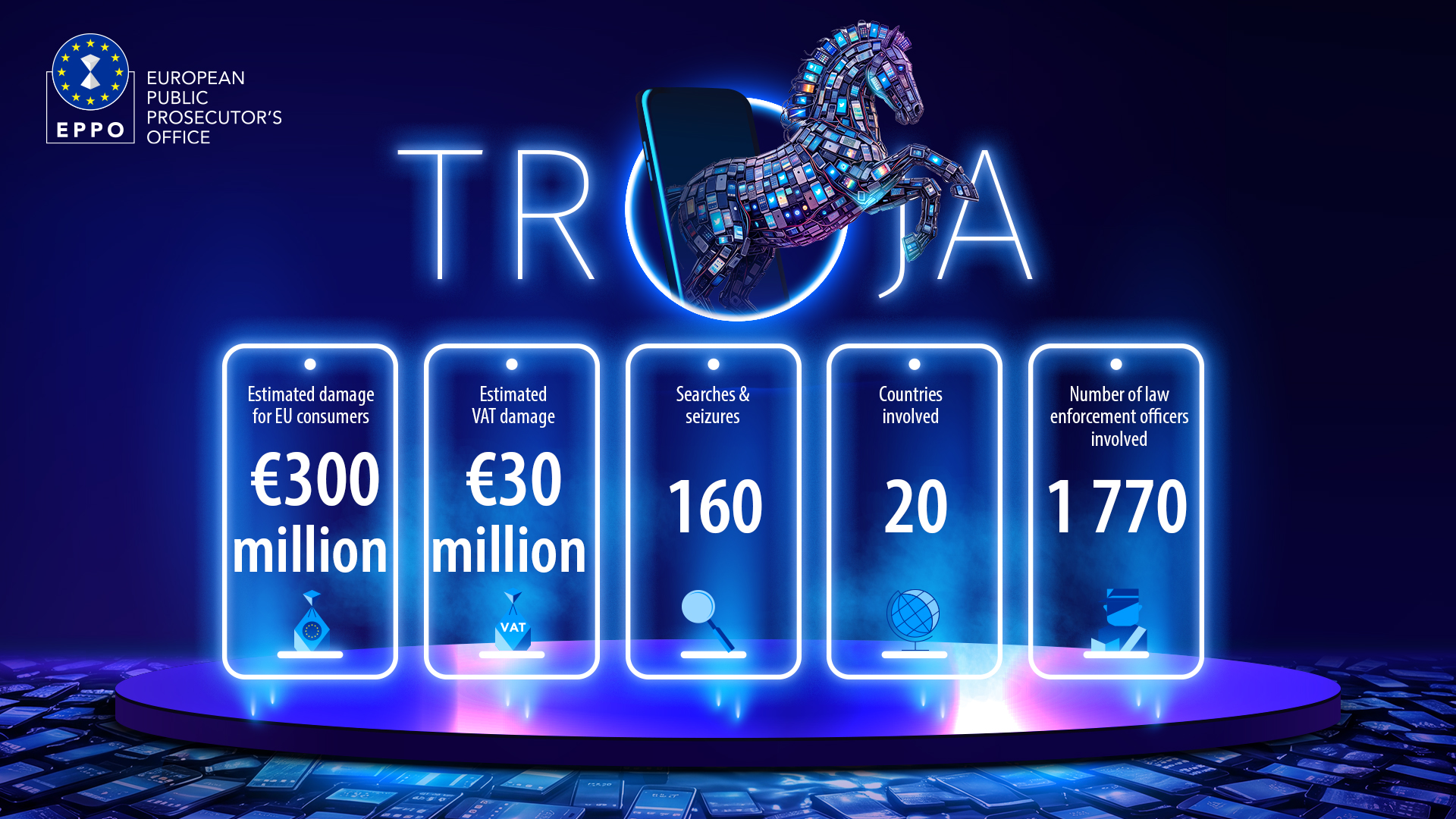
(Luxembourg, 29 September 2026) – The European Public Prosecutor’s Office (EPPO) in Cologne (Germany) has been conducting searches and arrests since last Saturday against a criminal organisation suspected of having sold over one million mobile phones as if they were new, while in reality they were used. The criminal scheme caused an estimated damage of at least €300 million to EU consumers and a VAT loss of over €30 million to several EU Member States.
1770 police, tax and customs officers carried out over 160 searches and seizures in 19 countries (Austria, Belgium, Bulgaria, Croatia, Cyprus, Estonia, Finland, Germany, Italy, Latvia, Lithuania, Luxembourg, Poland, Portugal, Romania, Slovakia, Spain, Switzerland and the Netherlands), and a witness was heard in the UK. Seven suspects were arrested in Austria, Germany and Spain, including the two leaders of the organisation.
According to the investigation, code-named ‘Troja’, a criminal organisation allegedly assembled mobile phones from used components in Hong Kong and the United Arab Emirates and then shipped them, cleaned and packaged as new mobile phones, to the Netherlands. Afterwards, they were transported to warehouses in Germany and sold on online marketplaces to end customers all over the EU.
The evidence further suggests that shell companies, based in several EU Member States (Austria, Bulgaria, Germany, the Netherlands) and Switzerland, fraudulently applied a reduced VAT scheme to the online sale of the mobile phones since 2018, to illicitly increase their profits. It is understood that these fraudulent mobile phones have been sold under the so-called ‘margin taxation’ scheme to end customers and between the shell companies. This taxation scheme, under which the reseller only has to pay VAT on the profit margin they make (the difference between the price paid for the item and the price for which it is sold), is applicable only to resold goods on which VAT had been paid already. However, having been sold as new goods, the VAT was due on the full price of the item. The scheme allegedly misled customers all around the EU, it also created a VAT damage in every country where these used mobile phones were sold as if they were new.
The investigation was initiated following a report from the European Anti-Fraud Office (OLAF).
All persons concerned are presumed innocent until proven guilty in the competent courts of law.
The EPPO is the independent public prosecution office of the European Union. It is responsible for investigating, prosecuting and bringing to judgment crimes against the financial interests of the EU.
List of main partners and national authorities involved in the action:
- Europol
- Eurojust
- Germany:
- Customs Investigation Office Essen – Cologne Branch (Zollfandungsamt Essen – Dienstsitz Köln)
- North Rhine-Westphalian Office for Combating Financial Crime (LBF – Landesamt zur Bekämpfung der Finanzkriminalität NRW)
- Düsseldorf Police (Polizeipräsidium Düsseldorf)
- State Bureau of Criminal Investigation North Rhine-Westphalia (Landeskriminalamt Düsseldorf)
- Public Prosecutor’s Office in Düsseldorf (Staatsanwaltschaft Düsseldorf) supported the asset recovery with administrative and legal support
- Austria: Anti-Fraud Office (Amt für Betrugsbekämpfung)
- Belgium: Federal Police
- Bulgaria: National Investigative Service (Национална следствена служба - НСлС)
- Czechia: Police (Policie České republiky)
- Croatia: Zagrebačka Police Department (Policijska uprava zagrebačka)
- Cyprus: The Office for Executing European Investigation Orders & Letters of Requests (Γραφείο Εκτέλεσης Ευρωπαϊκών Εντολών έρευνας και Αιτημάτων Δικαστικής Συνδρομής) and The Financial Intelligence Unit (MOKAS) (Μονάδα Χρηματοοικονομικών Πληροφοριών)
- Estonia: Estonian Tax and Customs Board (Maksu- ja Tolliamet – EMTA)
- Finland: Police (Poliisi)
- Italy: Italian Financial Police (Guardia di Finanza)
- Latvia: Tax and Customs Police (Nodokļu un muitas policija)
- Lithuania: Financial Crime Investigation Service (FCIS) under the Ministry of the Interior of the Republic of Lithuania (Finansinių nusikaltimų tyrimo tarnyba (FNTT) prie Lietuvos Respublikos vidaus reikalų ministerijos)
- Luxembourg: Judiciary Police (Service de Police Judiciaire – SPJ), Financial Intelligence Unit (Cellule de renseignement financier, CRF)
- Netherlands: Dutch Fiscal Information and Investigation Service (Fiscale inlichtingen- en opsporingsdienst – FIOD)
- Portugal: National Republican Guard (Guarda Nacional Republicana)
- Poland: Economic Crime Department of the Gdansk Municipal Police Headquarters (Komenda Miejska Policji w Gdansku, Wydział do Walki z Przestepczoscią Ekonomiczną)
- Slovakia: Office for Combating Organised Crime of the Police Force Headquarters (Úrad boja proti organizovanej kriminalite Prezídia Policajného zboru - ÚBOK)
- Spain: National Police Economic and Fiscal Crime Unit (UDEF)
- Switzerland: Federal Office for Customs and Border Security - FOCBS (Bundesamt für Zoll und Grenzsicherheit)
- United Kingdom: HM Revenue and Customs (HMRC)
- Publication date
- 29 September 2026
- Author
- European Public Prosecutor’s Office